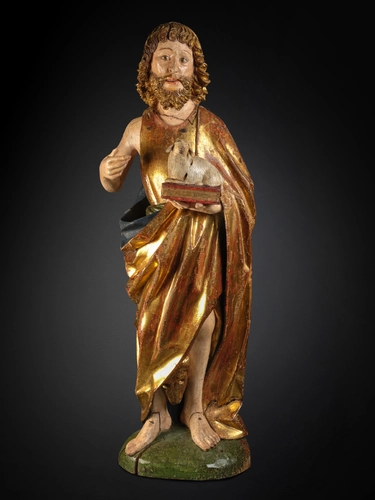
The artistic representation of Saint John the Baptist is a major theme in Christian iconography, as John the Baptist traditionally accompanies Christ throughout important episodes of his life. He has been depicted in various ways throughout the ages, as well as to illustrate different episodes of his life. Among the saints, John the Baptist occupied a privileged place in the Middle Ages, especially from the 15th century onwards, and particularly in the field of sculpture. Appearing here standing, the prophet is dressed in a sleeveless, round-necked tunic closed and tied at the waist, then covered by his hermit's cloak, which starts at his right shoulder and wraps around the saint, leaving his right arm free and stretched out in front of him. This oratorical gesture is thus associated with the symbolic significance of the Prophet's words (note also his half-open mouth, revealing his teeth), whose attribute, a lamb, is lying on a book evoking the Holy Scriptures placed on his left hand. A precursor and direct reference to the coming of Christ, it is in the Gospels that John refers to Jesus in these terms: ‘Behold the Lamb of God’. Straddling both sides of the Alps and shared between Austria and Italy, the region of Tyrol stands out in the artistic landscape of the late Middle Ages for its exceptional production of carved wooden sculptures. In close contact with the highly productive workshops of neighboring Swabia, local sculptors developed an art of outstanding quality, moving, gentle, and refined, perfectly exemplified by our Saint John the Baptist. Carved from a piece of lime wood, it retains almost all of its original polychromy and gilding, giving it a precious appearance, almost like a work of art. This remarkable sculpture is also impressive for its quality of execution and the care taken by the artist to distinguish its original physiognomy and highly decorative hair. A number of elements point to a chronology around 1470-1500. The face surrounded by round locks of hair curled outwards in the shape of a snail shell, the expression marked by gentleness and shyness, and the calm gestures (the head slightly tilted forward, the position of the right arm mentioned above) are characteristics specific to models developed during the second half of the 15th century. Emblematic for their Gothic style, these sculptures are notable for their restrained treatment of drapery, whose fluid and simple construction of folds contrasts sharply with the emblematic lyricism of the years 1500-1520. We can specifically compare our Saint John the Baptist to a series of sculptures from this period, namely: Saint John the Baptist dated 1470 in Stuttgart (Landesmuseum Württemberg, inv. no. 12887 a,b), Saint John the Baptist dated 1440–1450 in Antwerp (Museum Vleeshuis), but also of three beautiful Saint John the Baptists from the late 15th century, found in churches of the Diocese of Trento.