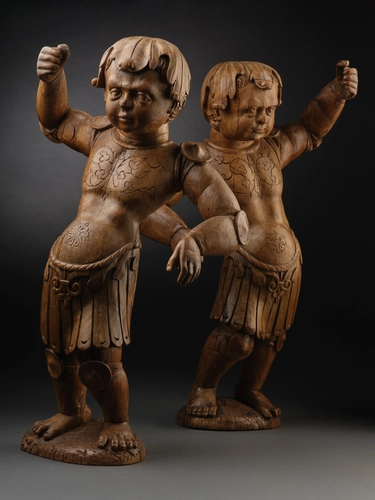
Renaissance-era ‘soldier’ putti, used as funerary or simply decorative sculptures, originated in Italy based on ancient models commonly found on Roman sarcophagi. Desiderio da Settignano (1428–1464) was among the first Italian Renaissance masters to revive the ancient motif of young shield bearers in contrapposto, as seen on the funerary monument of Carlo Marsuppini in the Church of Santa Croce in Florence (after 1453) and which played a decisive role in spreading this new taste for small male nudes symbolising cheerfulness, youth and innocence, a fashion trend that will take Europe by storm. Unlike Italian examples, which are characterised by a reserved and controlled expression, less playful than their northern counterparts, similar representations of putti in Germany are primarily characterised by their naturalism and often appear as mischievous as angelic children. Even when performing more serious tasks, such as holding the instruments of the Passion, the putti retain their serene and joyful appearance. Among the most beautiful iconographic examples are the two precious Armoured putti attributed to Hans Schwarz (dating from around 1520) kept at the Bayerisches Nationalmuseum in Munich and those designed by the workshop of Adolf Daucher and his son Hans, placed at the top of the high altar of St Anne's Church in Annaberg-Buchholz around 1520. Stylistically similar to the shield-bearing children of Annaberg are the iconic stone sculptures by Hans Daucher of the Shield Bearer with the Ducal Arms of Saxony (circa 1520), now in the Metropolitan Museum in New York, and the Two Putti lying on spheres, German Renaissance masterpieces created around 1525-1530, from the chapel of the prestigious Fugger family of merchants and bankers, recently acquired by the Maximilian Museum in Augsburg. Like his contemporaries, the Nuremberg-born sculptor Hans Peiser took an interest in this motif, producing particularly elaborate and decorative examples, generally figures such as ours in wood, preparatory to more imposing works in bronze such as the statue of the triumphant putto (circa 1550) that adorns the fountain in front of Nuremberg City Hall. Here, our armored putti were conceived as a pair with strong Mannerist accents, standing in a highly dynamic contrapposto pose with each one arm raised towards the sky. In a playful reinterpretation of classical mythology, the traditional deities are transformed into youthful warrior figures reflecting the German Renaissance's taste for fantasy and mischief: their hands once resting on shields and holding spears, their torsos clad in metal armor engraved with foliage and flowers, their heads adorned with an unusual vegetal headdress discreetly covering their hair.... With their princely bearing, richly dressed and protected by shoulder, elbow and knee guards, our figures join the particularly restricted corpus of Putti in armor made of wood and close in style to the art of Hans Schwarz (1492 - after 1521), Hans Peisser (circa 1505 - in 1571) or even Adolph Daucher (1486-1538), whose exceptional series formerly adorning the balustrade of the Fugger Chapel in Augsburg, now in the Bode Museum in Berlin, stands out here as a significant parallel. Rare examples of a type of Northern Renaissance sculpture from the era of Albrecht Dürer, our pair of Putti in armour is linked in style to the talented and refined schools of Augsburg and Nuremberg, among which its creator undoubtedly figures.