Circle of Benedetto DA MAIANO (Maiano 1442 - Florence 1497)
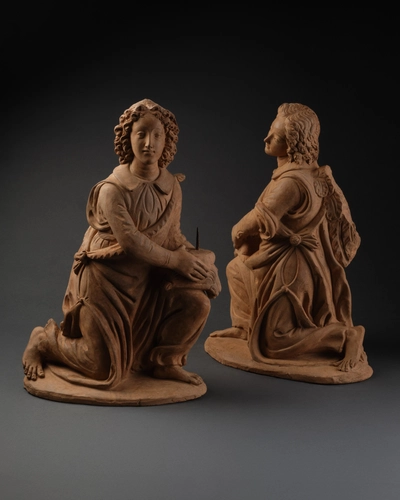
Pair of angels bearing candles
Terracotta
Florence
Renaissance
Circa 1480
39.5 cm( 15 35⁄64 in )
25.5 cm( 10 3⁄64 in )
50000€ - 100000€
These elegantly modelled terracotta angels are the work of a Florentine sculptor of the Quattrocento, following in the artistic tradition of Benedetto da Maiano (1442-1497). Depicted kneeling symmetrically, one on his right leg and the other on his left, they hold the base of a candlestick delicately placed on their knees with both hands. The iconography of ‘ceremonial’ angels occupied an important place in the liturgy of medieval and Renaissance churches, flanking altars, tabernacles and monumental crucifixes. Both symbolic and functional, they embodied the divine illumination of the holy mysteries; their gestures of offering or illumination reinforced the theological idea of angels as eternal acolytes in the service of God. Here, the stylistic vocabulary and design are distinctly Florentine - the youthful, idealised and androgynous facial features, and the rounded, supple drapery - seem to be inspired by the prototypes of the early Italian Renaissance, particularly the models of Benedetto da Maiano and Luca della Robbia, whom specialists agree are the formal references for the typology of our works. The success of their creations also led to a major fashion at the turn of the 16th century with the serial production of decorative “ceremonial angels”. As for the function of our statuettes, it suggests that they were probably designed to ultimately frame an altarpiece or a domestic tabernacle. The softness of the facial features, the overall plasticity and aesthetics, as well as the simplicity of the drapery, point towards a Daianesque style. characterised in particular by elongated faces with fine, arched brow ridges, as can be seen in the angel in the chapel in San Giminiano or the one preserved at the Accademia in Bergamo. Our modellos, original works intended to be reproduced on a larger scale in a noble material, are unique works for which there are no known equivalents today.