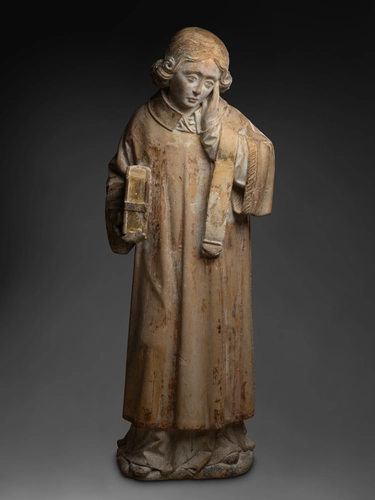
In this rare limestone sculpture from Apremont, late fifteenth-century French art reaches a peak of sensitivity. The young tonsured cleric, holding his book and brushing his cheek with a measured gesture, expresses not violent pain but an inner melancholy of deep spiritual resonance. This posture, inherited from antiquity and reinterpreted in the Middle Ages, evokes the tristitia secundum Deum, a form of sorrow that elevates the soul. Oscillating between the ideal image of a meditative cleric, a possible evocation of Saint Avertin - venerated for his healing of headaches - or even of Saint Stephen before his martyrdom, the work brings together a rich iconography in which contemplation, affliction, and spiritual hope intertwine. Through its restraint and silent intensity, it offered medieval viewers - and still offers us today - a model of right emotion, one that turns the heart towardreflection on divine mysteries. It guides the gaze and the emotions, teaching how to feel. In the inclined face and the hand resting against the cheek emerges an exemplary attitude, a perfect balance between human sorrow and spiritual dignity.