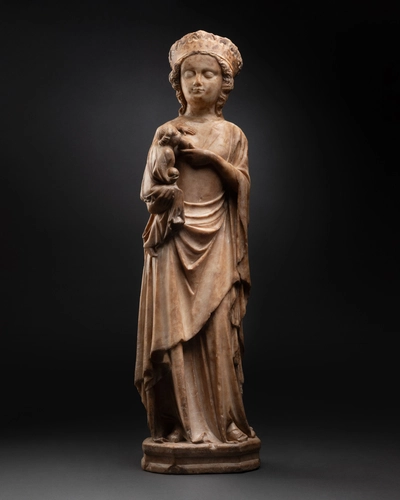
This alabaster Virgin and Child captivates through its striking presence: the softness of the face, the balanced posture, and the precious quality of the material combine to create an image of rare intensity, remarkably preserved despite nearly seven centuries of existence. That such a work has survived in this state is exceptional in itself. Moreover, belonging to the very first generation of English alabaster Virgins, a corpus limited to around fifteen known examples from the entire 14th century, confers on this sculpture a major historical significance. It stands at the very origins of an artistic tradition destined to become one of the most influential in medieval Europe. Since the 1330s, England has developed a singular relationship with alabaster. Nowhere else in Europe was this material worked with such consistency or inventiveness. While the 15th century saw the flourishing of abundant production of figures, altarpieces, and tombs aimed at a broad export market, surviving examples from the 14th century remain rare, often damaged, and offer only limited insight into the emergence of this sculptural language. It is precisely within this shadowed period that our work assumes a decisive role. Its early dating, around 1350–1375, its remarkable state of preservation, and the exceptional quality of its execution make it a key reference for understanding the beginnings of English alabaster sculpture.