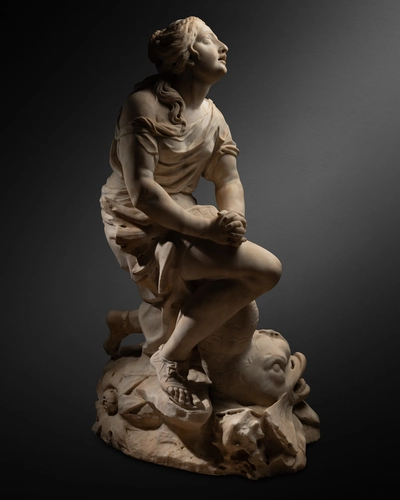
Entourage of Jacques SARRAZIN (Noyon 1592 - Paris 1660)
Nereid imploring (Thetis?)
Marble
France
Classic
1640 - 1660
100 cm( 39 3⁄8 in )
70 cm( 27 9⁄16 in )
200000€ > €
Full entry available upon request
Depicted kneeling with hands clasped in a gesture of supplication, this marine female figure is most likely Thetis, one of the most prominent of the Nereids—sea nymphs, daughters of Nereus and Doris. Identifiable by the dolphin and shell at her feet, she is shown here pleading with Poseidon on behalf of her son Achilles, prior to his departure for the Trojan War—a theme frequently chosen to adorn grand fountains in lavish gardens celebrating the majesty of Neptune. Both classical in spirit and imbued with references to late Italian Mannerism—notably the elongated neck, dramatic expression, and fluid drapery—this sculpture aligns with the French sculptural tradition under Louis XIII. It closely echoes the work of Jacques Sarrazin (1592–1660), who trained in Rome and became a leading figure of French classicism. His art combines clarity of form, formal elegance, and restrained expressivity. The presence of a spout within the dolphin’s mouth clearly indicates the work was conceived as a fountain sculpture, originally intended for installation in a nymphaeum or on the rocky base of a garden fountain, within a decorative scheme inspired by Italian models of grottoes and mythological water features. Introduced to France in the early 17th century, this tradition would reach its height under Louis XIV at Versailles, particularly in the celebrated Grotto of Thetis. Yet already, between the 1630s and 1650s, Sarrazin had given full expression to this repertoire in the nymphaea, grottoes, and gardens of such châteaux as Richelieu (Indre-et-Loire), Effiat (Puy-de-Dôme), Wideville (Yvelines), Chantemesle (Essonne), and Montmorency (Val-d’Oise). A rare surviving fragment of these now-vanished ensembles, this sculpture stands as a striking witness to the flourishing of garden art and mythological decorative sculpture in 17th-century France, situated at the crossroads of emerging French classicism and the early Baroque.