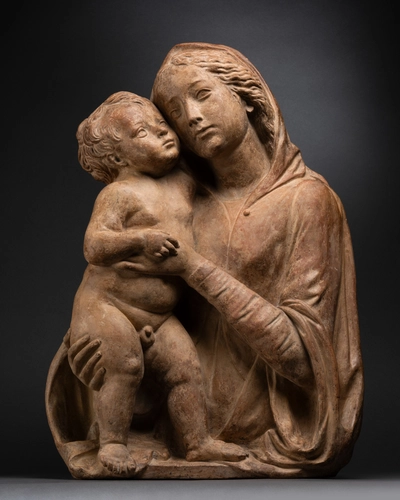
Workshop of Andrea DELLA ROBBIA (Florence 1435 - Florence 1525)
Virgin and Child
Terracotta
Florence
Renaissance
Circa 1500
50 cm( 19 11⁄16 in )
33 cm( 12 63⁄64 in )
100000€ - 200000€
Private collection
Workshop of Andrea della Robbia, Virgin and Child, Glazed terracotta, circa 1500, Boston, Museum of Fine Arts, 76.700
Full entry and thermoluminescence testing available upon request
In Medicean Florence, the Della Robbia family of sculptors and ceramicists left a lasting mark on their time by producing architectural ornaments and glazed terracotta sculptures—a technical process they pioneered and closely guarded for decades. The exceptional finish of their works—glossy and smooth surfaces, vibrant colors, and softly modeled forms imbued with the humanized spirituality of the Franciscans—secured their reputation for over a century across Tuscany, Umbria, and even into France.
This terracotta Madonna and Child can be attributed to the workshop of Andrea della Robbia (1435–1525), one of the most prominent members of this prestigious artistic dynasty. Within his oeuvre, this particular composition proved immensely popular, as evidenced by the numerous reliefs depicting a veiled bust-length Virgin tenderly holding the standing, haloed Christ Child against her side.
Our relief reinterprets this iconic model by presenting a nearly desacralized image of a youthful, gentle mother cradling her child in an enveloping gesture. Their faces are turned toward one another in close proximity, their gazes intertwined in a shared moment of tender contemplation. The Christ Child clasps his mother’s hand, resting on his side, in a profoundly moving and deeply human gesture. This physical and emotional intimacy conveys a palpable, immediate, and universal sense of tenderness.
Rare in its variation, this version finds close parallels only in a glazed relief at the Museum of Fine Arts in Boston and another from the former Tolentino Collection (1920), both attributed to Andrea’s workshop.
With its subtly reimagined composition and absence of glaze, this work stands both within and beyond the traditional corpus highly sought after by collectors and scholars of early sculpture. Its exceptional sensitivity and disarming humanity transcend the sacred, offering a timeless tribute to motherhood and to the artistic brilliance of the Renaissance.