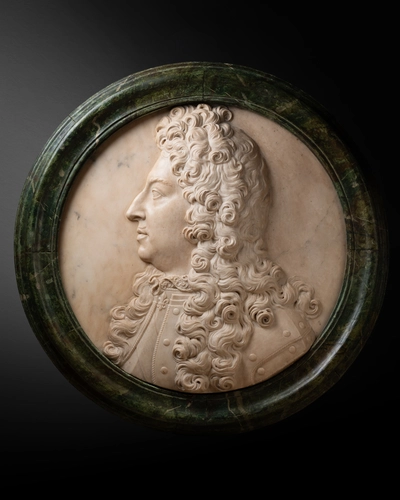
Attributed to François FONTELLE (Paris 1629 - Versailles 1690)
Portrait of Louis XIV
Marble
France
Classic
1680 - 1690
63 cm( 24 51⁄64 in )
200000€ > €
Sismann G., Sismann M., Lequio M., Clayeux R., Versailles Mania, Édition Librairie des Musée, Trouville-sur-Mer, 2026, n°18.
The royal portrait carved in a medallion first appeared in France in the early 16th century, during a period of enthusiasm for this “classical” architectural ornament imported from Italy. From Francis I to Louis XIV, this motif - inspired by the medal - served to glorify the sovereign in the manner of the Roman emperors. This motif experienced a revival during the reign of Louis XIV (1643-1715). The king was typically depicted in profile within a round or oval frame, sometimes crowned with a laurel wreath. Among the most famous examples are the medallions sculpted by François Fontelle, François Girardon, Pierre Puget, and Marc Arcis. This proliferation of medallion portraits was also part of a growing interest in ancient and modern medals, as evidenced by the publication of numerous works on numismatics, a field that reached its peak in the second half of the century. Louis XIV was the subject of a Metallic history; just like the emperors of antiquity. Intended primarily for public places, these portraits served to substitute for the sovereign’s presence in his provinces, as royal processions were no longer customary. This practice was thus part of the broader trend of “saturating public space”. The creation of these official portraits, whose imagery was strictly controlled by the state, was entrusted exclusively to the court sculptors and official portraitists of the king: François Girardon, Antoine Coysevox, Pierre Puget, Marc Arcis, Jacques Prou and François Fontelle. Our bas-relief is part of this policy of disseminating the royal image. Depicting Louis XIV in profile, as a bust, wearing an imposing wig and clad in a cuirass adorned with a fleur-de-lis, it presents a majestic and powerful image of the sovereign. The style and overall composition of this portrait are initially reminiscent of the medallion created by Jacques Prou upon his admission to the Royal Academy, which is now lost. But on closer inspection, it is the details in the quality of execution and the vertical treatment of the wig that point more towards the medallion created by François Fontelle at Versailles in 1686, now held in the Musée du Château de Versailles. It is to the latter that we attribute our medallion, which adds to the little-studied work of this artist, who worked at Versailles as a sculptor and decorator - notably in charge of the design of the Bosquet des Bains d’Apollon - until 1688.