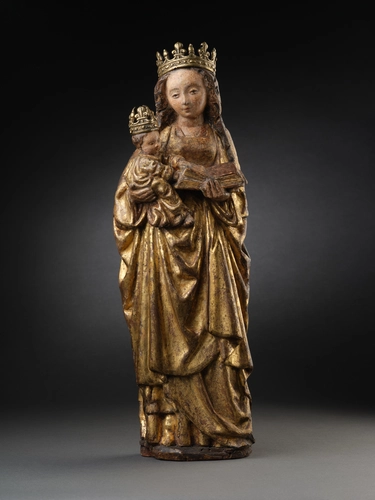
Five hundred years after their creation, the so-called “Malines dolls” continue to fascinate in many respects. During the first half of the sixteenth century, they were produced in large numbers, widely exported, and highly prized throughout Europe. Their small scale made them easy to transport. Serving at once as objects of devotion and of prestige, they were equally at home in the cells of nuns and in princely courts, whose travels they often accompanied. Yet beneath their apparent uniformity, these works—deeply influenced by Brussels sculpture of the Bormann dynasty and created from a shared repertoire of types and subjects, display infinite variations of style and personal nuance, lending them their distinctive charm and revealing the singularity of our Virgin and Child.