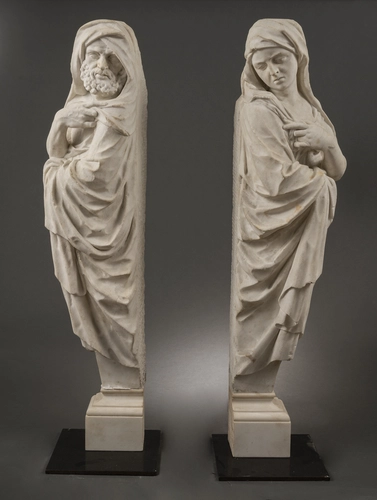
“Grandes Cheminées” Decor - Pair of caryatids from the reign of Louis XIV
Marble
France
Classic
End of the 17th century
91 cm( 35 53⁄64 in )
34 cm( 13 25⁄64 in )
30000€ - 50000€
Former Galerie Ratton-Ladrière Collection, Paris
Sismann G., Sismann M., Lequio M., Clayeux R., Versailles Mania, Édition Librairie des Musée, Trouville-sur-Mer, 2026, n°13.
In our collective understanding of sculpture during the reign of Louis XIV, the well-known names of Girardon, Coysevox, Puget, and Marsy often overshadow those of a myriad of other talented artists - whether academicians or not - active in the provinces or at the Versailles construction site. It is certainly to one of them, influenced by the iconographic models of François Girardon (1628-1715), that our pair of caryatids should be attributed. Indeed, it is to this leading artist and great sculptor of Louis XIV’s reign that we owe one of the most famous motifs of Grand Siècle sculpture, Winter, carved in marble between 1674 and 1683 to adorn the gardens of the Château de Versailles, and from which our male figure clearly draws inspiration. This work was created based on a drawing by Charles Le Brun (1619-1690), inspired by Roman art. Executed in 1674 in black chalk and gray wash, this drawing –now preserved in the Louvre Museum– depicts The Four Seasons, each in allegorical form. Our male figure, depicted as an elderly man wrapped tightly in his cape, is imbued with this pathos. The bite of the cold, as well as the passage of years, is visible in his tense face and veined hands. As for our female figure, the solemn expression on her face, her crossed hands, and her fabric drawn up over her head echo Girardon’s Mater Dolorosa, sculpted in 1657 in an oval marble medallion. The slender silhouettes of both sculptures, along with the slight flattening observed on the tops of their heads, suggest that these allegories once served as supports within an architectural decoration or monument. Their evident symmetry implies that they framed a central element essential to the understanding of the whole. These two caryatids may well have adorned a monumental fireplace, as the imagery depicting winter suggests. Positioned outside the hearth, around the surround and at each end, the two draped figures are echoed in the designs for the ‘Grandes cheminées’ created by Jean Lepautre around the 1660s.