Sismann G., Sismann M., Lequio M., Clayeux R., Versailles Mania, Édition Librairie des Musée, Trouville-sur-Mer, 2026, n°2.
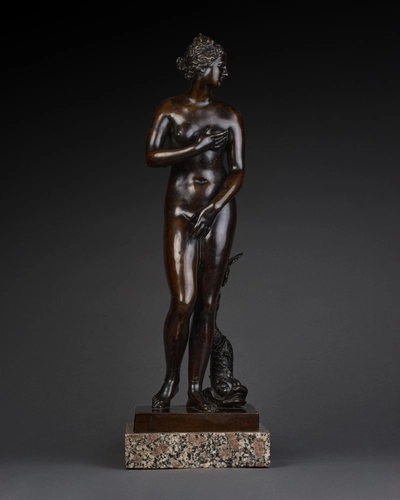
This bronze Venus perfectly illustrates the European elite’s fascination with copies of ancient works, which were particularly prized in France beginning in the 16th century. Our female figure was modelled after the Medici Venus, now held in the Uffizi Gallery in Florence. It was first mentioned at the Villa Medici in Rome in 1638. It was sent to Florence in 1677 to be exhibited there in 1688 in the Tribune of the Uffizi. The Medici Venus remains one of the most copied sculptures of all time. The Medici Venus model was particularly popular during the reign of Louis XIV, as evidenced by the several versions found in the gardens and apartments of the Palace of Versailles. Our Venus follows in the tradition of these copies intended to adorn the private interiors of the elite. Our Medici Venus, while embodying the pronounced taste for antiquity during the reign of the Sun King, also illustrates an evolution in artistic ideals. It features a figure that is more elongated compared to the ancient model and its 17th-century Versailles interpretations: the shoulders are broader and the hips more pronounced. Indeed, her reimagined proportions reveal an appropriation of the classical model while situating it within the tradition of copying. Dating from the early 18th century, she attests to the longevity of the Medici model and the need to renew the classical ideal in a more classical version in keeping with the spirit of the times.