By the end of the Modern Era, Venice presented the paradoxical image of a power in decline, where the splendour of appearances masked a slow political decline. La Serenissima, whilst seeing its maritime hegemony eroded, remained a commercial hub of exceptional vitality, fuelled by constant trade with the East. This openness fostered a deep fascination with the distant lands of Africa and Asia, whose forms, materials and imagery had a lasting influence on Venetian art, which served as a key conduit for them. Whilst sumptuous architecture, great painting and monumental sculpture experienced dazzling developments, a veritable golden age of wood also emerged between the 17th and 18th centuries. A quintessentially Venetian material, born of the meeting of land and water, it became the medium for unrivalled virtuosity: wood then rivalled marble in its inventiveness and expressive intensity, seeming to come to life under the chisels of the masters.
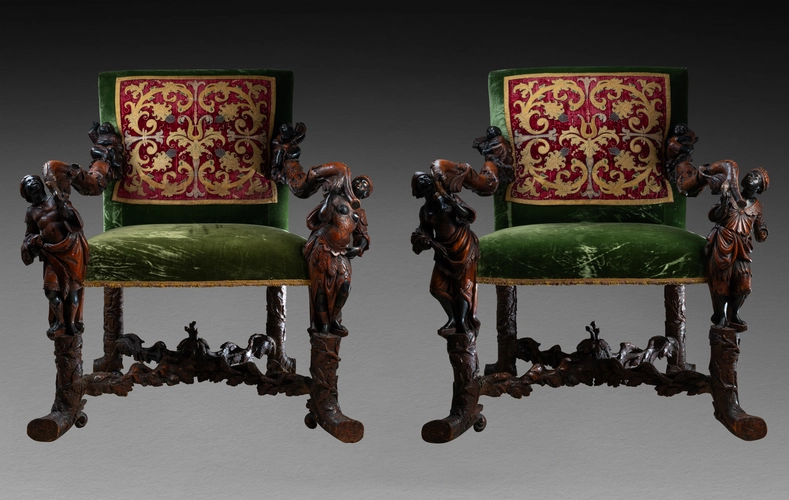
It is against this backdrop that this pair of armchairs is set, blurring the boundaries between furniture and sculpture and distinguished by a profoundly organic design in which the structure seems to spring from a living, intertwining plant: the legs, crossbars and armrests take on the appearance of gnarled trunks, entwined with vine shoots and vine leaves in an almost naturalistic display. Far from being purely ornamental, this decoration becomes a stage, inhabited by a rich procession of sculpted figures. Halfway up the front legs stand figures in exotic costumes acting as telamons, supporting the armrests with one shoulder in a skilfully dramatised pose. Comparable to the ‘Moors’ favoured in Venetian iconography, they are echoed in the moretti (‘little Moors’), these dark-skinned putti reclining on the armrests, ensuring the transition to the backrest whilst enlivening the composition with a presence that is both playful and precious. The ensemble thus forms a veritable theatre of wood, whose profusion and virtuosity are further enhanced by a rich trim of embroidered velvet, affirming the spectacular nature of these seats, designed less for practical use than as true ceremonial pieces.
Our pair of armchairs lies at the intersection of several trends characteristic of late 17th-century Venice: an enduring taste for the exotic, the final flourish of the Baroque, a creative effervescence in the field of sculpture, but also inventive reinterpretations and the gradual adaptation of furniture to the evolving demands of both comfort and representation. From this perspective, the hypothesis that they were commissioned for the music room of a Venetian palace seems particularly plausible: the presence of the musician figures, the theatricality of the structure and the richness of the decoration suggest a space dedicated to aristocratic socialising, where the furniture, much like the musical performance itself, plays a full part in showcasing the patron’s taste and status. These seats, both functional objects and sculpted works, thus encapsulate the Venetian ambition to turn everyday life into a veritable spectacle of refinement, where art, music and social prestige come together in a single sensory experience.