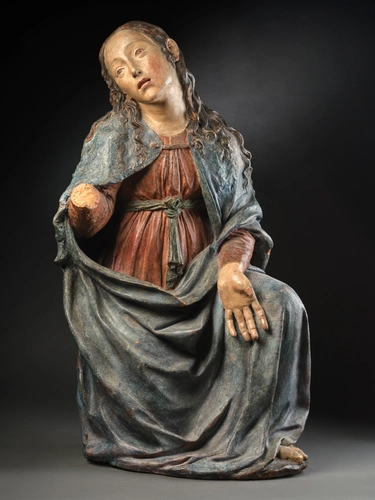
Florence (formerly part of the Altar of the Pieta of Santa Maria Nipotecosa)
Middle Ages
1485 - 1488
80 cm( 31 1⁄2 in )
48 cm( 18 57⁄64 in )
200000€ > €
Luigi Bellini, Florence
Private collection, Monte Carlo
Salander-O’Reilly Galleries, New York
The Collection of Hester Diamond Part I, 29 January 2021,, Sotheby’s New-York
F. Caglioti, ‘Nuove terrecotte di Benedetto da Maiano,’ in Prospettiva. Revista di storia dell’arte e moderna, extract 126-127, April – July 2007, pp. 15-46, figs. 27-28 and 33-34 (illus.).
A. Bellandi, Leonardo del Tasso – Scultore fiorentino del Rinascimento, Mizen Fine Art Edizioni, 2016, p. 57, fig. 61.
This terracotta sculpture by Benedetto da Maiano depicts Mary Magdalene in the throes of deep sorrow after the death of Christ. Her gestures and expression convey intense and dignified grief, inviting prayer and meditation. Originally, this work was part of a group of four figures - depicting The Lamentation in the church of Santa Maria Nipotecosa in Florence - commissioned in 1480 by a wealthy wool merchant. Mary Magdalene’s position suggests she was placed at the far right of the scene. In 1997, Giancarlo Gentilini attributed to Benedetto and The Lamentation group a Pietà now in La Spezia, highlighting its typical late 15th-century style. In 2000, Francesco Caglioti confirmed this attribution through archival research, dating the Mary Magdalene between 1485 and 1488. Caglioti also drew comparisons with other Florentine Lamentations from the 15th century and suggested that Mary Magdalene’s right hand may never have existed, allowing her figure to be contiguous with the legs of the reclining Christ. Stylistic comparisons with other works by Benedetto, such as the Saint John the Evangelist in Naples, further support this attribution. The “V”-shaped folds of the drapery and the wavy hair are recurring features of the artist’s work. Renowned for the aesthetic quality of his works and the importance of his patrons, Benedetto da Maiano (1442–1497) is one of the most significant Italian sculptors of the 15th century. As a teacher of Michelangelo, he paved the way for High Renaissance sculpture. Thus, our Mary Magdalene stands among the works that, at the end of the Quattrocento, redefined Italian sculpture.