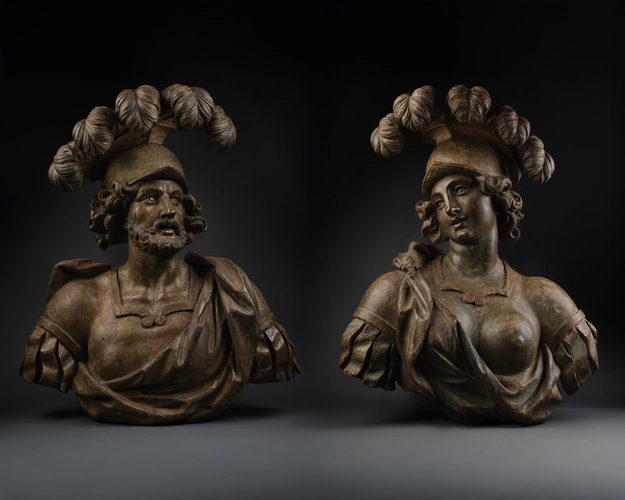
Pair of Baroque Applique Busts of Mars and Minerva
Wood
Bavaria
1700
67 cm( 26 3⁄8 in )
58 cm( 22 53⁄64 in )
50000€ - 100000€
Imposing in their life-size dimensions and graphic power, our pair of mythological appliqué busts are helmeted and dressed in Roman army attire. Here, our female portrait evokes a personification of Minerva, depicted with the idealized features of a young woman whose left breast stands out voluptuously beneath her breastplate. The male portrait, on the other hand, can be interpreted as a personification of Mars. Both draped in the classical style and wearing helmets sumptuously adorned with five ostrich feathers, our warrior and conquering deities stand side by side in perfect symmetry, as if they had been designed to occupy the place of honor in a grand decorative composition (perhaps wood paneling?). The style of these works places them within the "Bavaria of the Enlightenment," a time and place marked by the rich decorative style of sculptures originating particularly from the Munich and Nuremberg regions. With their vibrant colors and often intense emotions, the Rococo art of southern Germany is not only exceptionally refined, but also expresses a great lightness, frequently incorporating visual elements that are both decorative and metaphorical. Through the combination of its elegance, expressive power, and spiritual dimension, the Bavarian artist seeks to ensure that the viewer fully appreciates their virtuosity. The vivacity and spirit of the wooden figures best illustrate the sculptural mastery of this movement, which is both profound and visually stimulating. Our sculptures can be particularly compared to two life-size wooden figures representing Saint George and Saint Mauritius, created by the Nuremberg artist Johann Michael Schaller (1680-1750), now housed in the Nuremberg National Museum. Indeed, these two works share silhouettes and physiognomies similar to our own, as well as a treatment of clothing (down to the detail of the cuirass collars) that is entirely comparable. Along with this pair of Schaller busts, a third work emerges as a stylistic reference for our spectacular busts: "Minerva of the Bucentaur," a sculpture from the grand ceremonial ship (Bucentaur) of the Bavarian electors, executed in 1663 by the great court artist Balthasar Ableithner (1614-1705), and now housed in the Bayerisches Nationalmuseum in Munich. The taste in Bavaria for its life-size mythological figures in wood continued throughout the 18th century, reaching its peak in the works of sculptors Johann Baptist Straub (1704-1784) and Ignaz Günther (1725-1775).