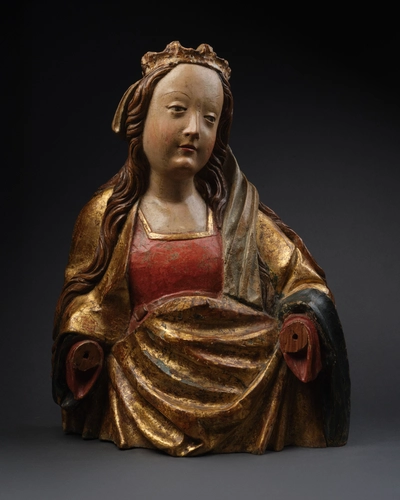
Since the nineteenth century, and even more so in recent years, whenever they make their rare appearances on the art market, the delicate and expressive creations of Swabia have captivated enthusiasts and collectors of early sculpture. Nowhere else in Europe is the carving of wood imbued with such a unique blend of strength and sensitivity. These workshops produced chiefly altarpieces intended for export. Among them, Memmingen in the Allgäu stands out as a major artistic centre, thanks in large part to the Strigel family. The workshop of Ivo Strigel, active between 1459 and 1516, was responsible for numerous works sent to the Swiss valleys. Ivo Strigel oversaw the collaboration of sculptors and painters, acting as both master and organiser of commissions. Although the workshop’s output can be divided into three periods, this sculpture belongs to the earliest (1485-1490), which includes the altarpieces of Disentis, Brigels, Lumbrein and Obersaxen. It depicts a veiled young woman wearing a red tunic and a mantle with sharply broken folds. The crown identifies her as the Virgin or a young saint, though her attributes have been lost. The veil falls in a long panel of straight pleats, a recurring motif in the Strigel workshop. The sinuous silhouette, inclined neck and feminine type recall the Mary Magdalene of the Obersaxen altarpiece, the Virgin from the Lumbrein altarpiece, and Saint Margaret from the Weiller retable. The faces show a full oval, high forehead, rounded cheeks and lowered eyes, lending a serene expression. The carved locks cascade in interlaced curls over the shoulders, animating the composition with subtle grace. The polychromy follows the Strigel formula: pale flesh tones, vivid pink accents, and precise delineation of facial features. These traits reveal a shared stylistic language within the workshop, likely the work of a single sculptor active under Ivo Strigel in Memmingen. Rare on the market, such works embody one of the high points of late medieval German art. Carved from a light limewood and hollowed at the back, this figure is a precious fragment of the tradition of altarpieces exported to the Alpine regions. It offers collectors the rare opportunity to acquire a work imbued with the gentleness, balance and poetic spirit characteristic of Swabian creations from the late fifteenth century.