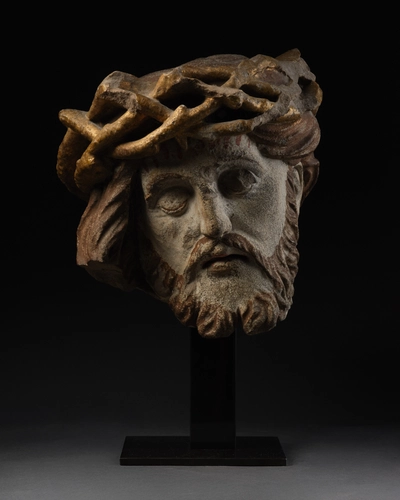
At the turn of the sixteenth century, as the eastern regions of the Kingdom of France were experiencing a profound renewal in religious sculpture, the image of Christ became the focus of an unprecedented intensification of expression. Rooted in the late Gothic tradition yet already responsive to emerging naturalistic concerns, this period gave rise to works of remarkable spiritual density, in which sacred suffering is combined with a deeply embodied sense of humanity. The present head of Christ fully belongs to this fertile moment of transition. A fragment of a larger sculptural ensemble, probably a Crucifix, this sandstone head is immediately striking for the silent gravity it conveys. The face is inclined, the eyelids closed, the mouth slightly parted, suggesting the final surrender of the martyred body. The crown of thorns, carved in broad, thick interlacings, rests firmly upon the skull. The sculpture stands out for the quality of its handling of volume: the planes are clearly articulated, the edges sharply defined, particularly in the deeply carved beard and hair. This direct and emphatic carving gives the surface a forceful, almost rugged vitality, heightened by the very nature of the sandstone. The choice of this material, characteristic of the eastern regions of France, lends the work a strong mineral presence and a distinctive expressive density. Well-preserved traces of original polychromy and gilding further enhance the reading of the sculpture as a devotional object, intended to inspire compassion and contemplation in the faithful.