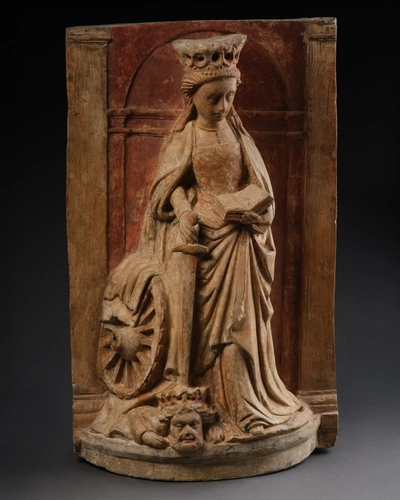
At the turn of the sixteenth century, the Burgundian Netherlands constituted a politically, economically, and culturally prosperous entity. This territory, which notably included the Duchy of Burgundy, Flanders, Brabant, Artois, and the Principality of Liège, was one of the principal artistic centers of Northern Europe. Driven by the dynamism of its cities, the wealth generated by trade, and sustained patronage from both religious institutions and secular elites, the arts flourished and sculptural commissions abounded. In the major cities of Flanders and Brabant, the production of carved wooden altarpieces reached its golden age and was exported throughout Europe. At the same time, Tonnerre stone, quarried in Burgundy, enjoyed a high reputation and was widely exported to the Burgundian Netherlands, where it was occasionally used for altarpieces, altars, and monumental sculptures, illustrating the circulation of materials and artistic models within this region. The sculpture presented here, carved from this Tonnerre stone, is executed in very high relief against an architectural backdrop forming a semicircular niche. A female figure stands in a calm and solemn pose, with a slight contrapposto that lends the composition a measured elegance. The drapery, broad and deeply undercut, animates the surface and reveals a strong command of volume. Traces of ancient polychromy remain in the recesses and on the background, hinting at the work’s original chromatic richness. The flat back indicates a sculpture intended to be set against an architectural framework, inviting a frontal viewing.