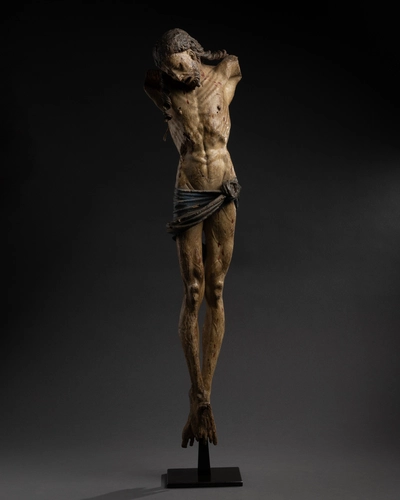
Suspended in an almost choreographic posture, this Christ carved in lightweight wood immediately impresses through the extreme tension of his body and the intense expressiveness of his presence. Far removed from any serene or idealized image, it embodies a profoundly dolorous vision of the Crucifixion, in which suffering is inscribed in every fiber of the wood. The sculpture establishes a physical relationship with the viewer: the body is stretched to the point of instability, as if held between gravity and elevation, endowing the figure with a paradoxical grace, fragile and almost dance-like.The work is distinguished by a radically expressive treatment: a narrow, deeply hollowed torso, musculature stretched to its limits, long and nervous legs, and a restrained perizonium that emphasizes the purity of the silhouette. Subtle yet precise traces of polychromy further heighten the pathos of the figure. Carved from a lightweight wood, probably linden, this Christ belongs to the great sculptural tradition of southern Germany, where such material was favored from the late Middle Ages into the early Renaissance. Through its extreme elongation and dramatic force, the sculpture engages closely with the expressive current inaugurated by Veit Stoss, extending his legacy while departing from it through a more taut and personal formal language. In certain respects, the figure also recalls the sculptural explorations of the Swabian sphere, notably those associated with Michel and Gregor Erhart, in which bodily grace is combined with heightened emotional intensity. Created in the second quart of the sixteenth century by a sculptor of considerable talent, this rare and striking Christ stands as a major testimony to one of the most inventive periods of German sculpture, when excess became language and deformation, emotion.