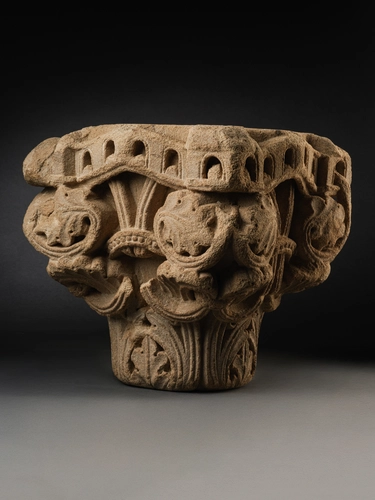
This Vosges sandstone capital stands out for the elegance and strength of its execution, reflecting the virtuosity of the Romanesque workshops of the Upper Rhine in the mid-12th century. Its exceptional quality, combining sculptural power with decorative finesse, makes it an exemplary instance of the region’s sculptors’ ability to harmonize monumentality, formal clarity, and ornamentation. The density of its volumes, the flat, ribbed leaves with rounded lobes, its rhythm, and the elegance of its ribbon-like, beaded tendrils establish a connection between this work and the Romanesque frieze of the transept of the Saint-Laurent Abbey in Hesse, Moselle, near the Vosges massif. These stylistic features, observed at Hesse, derive directly from the sculptural language developed at the Basel Cathedral construction site, particularly from the friezes above the choir capitals, executed between 1185 and 1200. Their decorative unity is ensured by the typically Basel motif of the diamond-pointed strap, partially echoed in our capital. It is likely that artisans who worked on this key site participated in the creation of the Hesse frieze, and that our capital is the product of the same itinerant workshop network, which spread widely, even into Germany, making this work an exceptional testimony to the artistic exchanges of the 12th century.