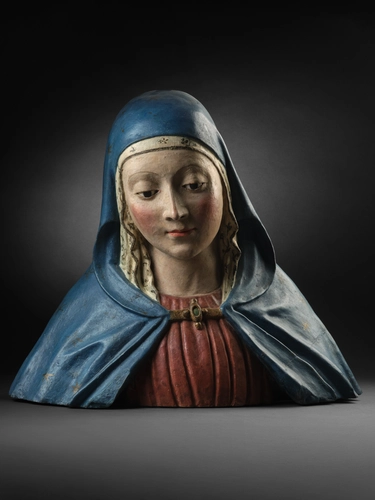
From the late 12th century onward, the Abruzzo region distinguished itself through the production of exceptionally high-quality sculpted Madonnas with Child. This superb terracotta bust of the Madonna bears witness to the persistence of this artistic tradition during the Renaissance in the 15th century, a time when the region’s principal center, L'Aquila, reached its zenith. As the leading city of Abruzzo - then part of the Kingdom of Naples - L'Aquila became an essential stop along the route connecting Florence to Naples via Perugia, one of the most traveled paths by diplomats, merchants, and scholars of the era. Until 1500, this humanist city enjoyed remarkable prosperity and autonomy, fostering an extraordinary artistic flourishing. This was driven by great talents like Silvestro dell'Aquila, a master of sculpture and architecture in Abruzzo, whose work was deeply influenced by the art of Verrocchio, with whom he studied in Florence during the 1470s. Silvestro was responsible for a significant production of renowned Madonnas with Child, including the Madonna del Grazie of Teramo, the Enthroned Virgin at the Galleria Antichi Maestri Pintorri in Turin, and the one in the Basilica of San Bernardino in L'Aquila. He collaborated closely with numerous assistants and pupils, who later spread his distinctive formulas throughout the region. These artists developed their own interpretations, giving rise to a unique local typology of Madonnas. These were characterized by large seated terracotta figures with oval faces, draped in heavy veils that clung to Mary’s forehead, forming more or less defined cones at her temples before spreading into two arcs joined by an ornate clasp at her chest. These features can be observed in a Madonna del Latte from the Diocese of Rieti, attributed to the Circle of Silvestro dell'Aquila; in a Madonna and Child from the Master’s School, now housed in the Musei Nazionali d'Abruzzo; in another by Carlo dell'Aquila; and in the bust we see here.