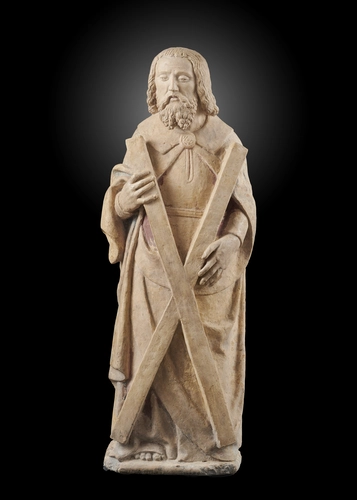
This fine Saint Andrew belongs to the artistic production of the second half of the 15th century, at the crossroads between Savoy, Bresse, and Dauphiné. In these border regions, where artists, models, and influences intersect, sculpture experienced a remarkable flourishing, sustained by the patronage of local religious communities and major benefactors. It is within this fertile context that our representation of Saint Andrew should be placed—a figure embodying peaceful spirituality and exemplary formal mastery.
Carved most likely from Jurassic limestone quarried east of Bourg-en-Bresse (in Drom or Hauteville), the sculpture’s overall volume is compact and solidly structured around a vertical axis. The ample, measured drapery falls in supple, orderly folds, free of decorative excess. This economy of means, which favors clarity of design, is complemented by meticulous attention to detail: the finely chiseled clasp and collar of the tunic add a touch of elegance that enhances the work’s overall sobriety. This subtle balance between restraint and refinement gives the figure a quiet nobility, where contained strength meets the grace of the modeled form.
The sculpture can be compared to a group of works from the same cultural area, notably the Saint Anthony of Chanoz-Châtenay (Church of Saint Martin) and the Mary Magdalene of Marsonnas (Church of Saints Peter and Paul). These figures share with our Saint Andrew a preference for compact volumes, the softness of drapery, and the clarity of line.
Before reaching us, the work was first brought to light by Marguerite Motte, a Viennese-born gallerist and pioneer of the Swiss art market. Her first gallery opened in Geneva in 1948, followed by a prestigious Paris branch at 22 rue Bonaparte, active between 1963 and 1973, where the sculpture was acquired by an American collector. On May 22, 1979, it was presented in a major Sotheby’s sale in New York. This distinguished provenance reflects the enduring renown of this remarkable sculpture, now reappearing on the international stage through Galerie Sismann.