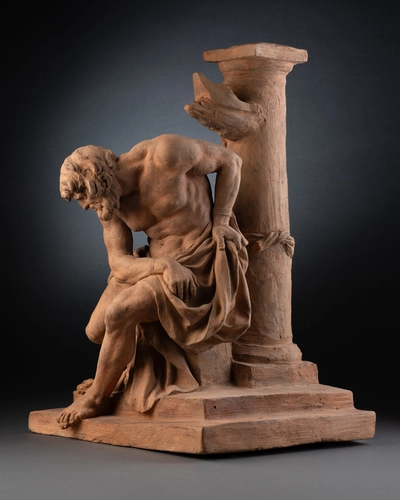
Entourage of Antoine COYSEVOX (Lyon 1640 - Paris 1720)
Allegory of a Vanquished Nation (The Empire?)
Terracotta
France
Classic
First half of the 18th century
38 cm( 14 61⁄64 in )
26 cm( 10 15⁄64 in )
0€ - 15000€
Munich, Galerie Julius Bölher, 2021 Londres, Christie’s, 4 décembre 2019, lot. 222 Londres, Christie’s, 8 juillet 2010, n°136 Londres, Mallett at Bourdon House, Sculptures in terracotta, 1963, n°10, ill.; Michael Jaff et descendants, Londres
Herding, K. ; (rev.) Bresc-Bautier, G., Pierre Puget (1620-1694), Faton, 2024, vol. 4, p. 121, SC-rj139
Full entry and thermoluminescence testing available upon request
Some works, through their evocative power, transcend time, continuing to provoke fascination and scholarly debate. This terracotta sculpture is a prime example: repeatedly published, it has inspired numerous interpretations, even drawing associations with two towering figures of seventeenth-century French sculpture—Pierre Puget and Antoine Coysevox. This dual attribution, both prestigious and enigmatic, underscores the expressive force and formal ambition of this modello, whose subject is deeply political.
An allegory of a vanquished nation, the figure is shown seated and slumped against a rostral column. The sculpture draws on an iconographic tradition rooted in Antiquity and revived in the seventeenth century, notably by Martin Desjardins in the monumental statue erected in Place des Victoires in Paris in honor of Louis XIV, and by Jean-Baptiste Tuby and Antoine Coysevox in the Versailles fountain La France triomphante.
Although long attributed to Puget or one of his followers, the undeniable formal and iconographic parallels between this figure and that of the vanquished Empire in the Versailles fountain suggest that the work more likely originates from Coysevox’s circle. Its reduced scale, terracotta medium, and the meticulous attention to modeling strongly indicate that it was conceived as a preparatory model for a commemorative or ephemeral monument, likely celebrating a naval victory—as suggested by the presence of the rostral column. Fragmentary elements at the base further support the idea of a larger composition, possibly including a second, complementary figure.
At the crossroads of classical heritage and monarchical political program, this terracotta combines expressive vigor and allegorical rigor in a compact but deeply evocative form. It demonstrates a brilliant lineage with the great royal commissions, referencing the models of Antoine Coysevox and adopting his balanced style. As such, it preserves the precious memory of a lost monument or an ambitious unrealized project, conceived within the artistic circle of the most celebrated sculptor of the Grand Siècle.