Full entry and thermoluminescence testing available upon request
A French Terracotta Tiber: A Rare Variation on an Iconic Antique Model
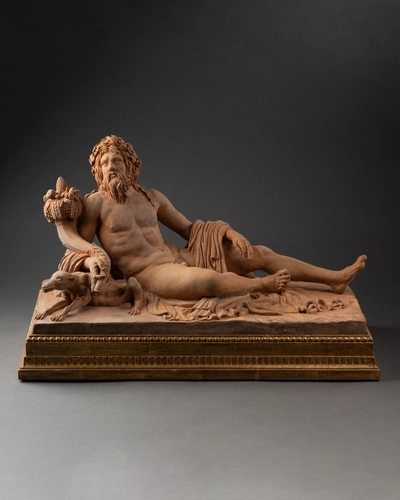
This allegorical figure of the Tiber, modeled in terracotta at the turn of the 17th and 18th centuries, presents a refined French reinterpretation of one of the most renowned antique marbles, now housed in the Louvre Museum. Inspired by the colossal marble statue unearthed in Rome in 1512—depicting the river as a muscular elder, reclining on a cornucopia, holding a ship’s rudder and sheltering Romulus and Remus beneath his arm—our sculpture departs from its source in several deliberate ways: the twins are omitted, the rudder is absent, and the she-wolf turns her head outward in a watchful, almost defensive stance.
By the late 17th century, under the patronage of the Marquis de Louvois, both the Tiber and its counterpart, the Nile, were reproduced in marble for the gardens of the Château de Marly and disseminated in a range of formats to adorn collectors' cabinets. While bronze reductions became highly sought after, terracotta versions such as the present work remain exceptionally rare.
Freely inspired by the antique model yet unbound by its iconographic conventions, this sculpture asserts a creative independence. It vividly illustrates how artists of the Grand Siècle reinterpreted classical forms to develop a renewed visual language—one that reflects the elegance, refinement, and inventive spirit of the emerging French taste at the dawn of the 18th century.